Traffic lights automatically adjust to clear congestion. Energy grids are predicting power surges before they happen. Emergency vehicles communicate instantly with hospital networks. These are the hallmarks of a smart city.
We often think of these advancements as purely wireless or cloud-based magic. The reality is much more grounded.
All of this seamless communication relies on massive amounts of data traveling at the speed of light. That data needs a physical pathway. Enter the fiber optic cable. These thin strands of glass carry the lifeblood of modern urban innovation.
The people responsible for building and maintaining these complex networks are fiber optic technicians. Without their specialized skills, the concept of a smart city falls apart completely. Let us explore exactly how these professionals form the backbone of our future urban environments.
The foundation of urban connectivity
A smart city uses thousands of interconnected sensors and devices. These devices monitor everything from air quality and water levels to public transit schedules and pedestrian traffic. Gathering this data is only the first step. The information must be transmitted to central hubs, analyzed, and returned as actionable commands within milliseconds.
Traditional copper wiring simply cannot handle this volume of information. Fiber optic cables provide the necessary bandwidth, speed, and reliability. They are immune to electromagnetic interference, which is highly common in dense urban areas filled with power lines and radio signals.
Fiber optic technicians are the experts who physically install these high-capacity networks. They pull delicate glass cables through miles of underground conduits. They splice fibers together with microscopic precision. Every successful connection they make ensures that a city’s vital data flows without interruption.
Core responsibilities driving city growth
The work of a fiber optic technician goes far beyond simply plugging in a cable. Their daily tasks directly enable a city to upgrade its infrastructure and offer new services to residents.
Installing the physical network
Before a municipality can roll out a new smart traffic system or public Wi-Fi network, technicians must lay the groundwork. This involves reading complex blueprints, navigating existing underground utility lines, and carefully routing fragile cables.
They use specialized equipment to test the integrity of the lines before they ever go live. A single micro-fracture in the glass can compromise an entire neighborhood’s connectivity.
Maintaining and troubleshooting systems
Smart cities operate around the clock. When a data connection drops, it can disrupt essential municipal services. Fiber optic technicians are the first responders for the digital infrastructure. They use advanced diagnostic tools such as Optical Time Domain Reflectometers (OTDR) to pinpoint exact breaks or signal losses along miles of cable. By quickly isolating and repairing these faults, they minimize downtime and keep the city running smoothly.
Expanding for future technologies
Urban environments are constantly evolving. As cities prepare for widespread autonomous vehicle deployment and 5G network expansion, the demand for fiber infrastructure skyrockets. 5G towers require fiber optic connections to transmit their massive data loads back to the core network. Technicians are currently upgrading existing networks and installing new lines to support these emerging technologies. They ensure the city has the capacity to grow.
Navigating urban challenges
Working in a bustling metropolis presents unique challenges for fiber-optic professionals. They rarely have the luxury of a clean, empty workspace.
Technicians must often navigate centuries-old infrastructure. Pulling new cables through cramped, aging underground vaults requires careful planning and immense patience. They work in extreme weather conditions, from freezing snowstorms to sweltering summer heat, knowing the city depends on their progress.
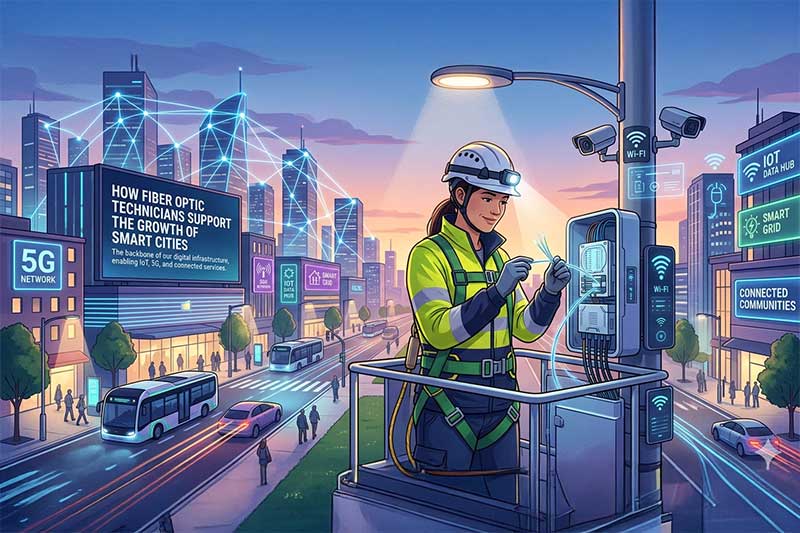
Furthermore, splicing fiber optic cables demands surgical precision. The glass strands are thinner than a human hair. Technicians must align and fuse these strands perfectly using a fusion splicer, often while working in a cramped manhole or high up in a bucket truck. The environment is harsh, but the required work is incredibly delicate.
Empowering the future of urban living
The next time you notice a digitally updated bus schedule or a perfectly timed traffic light, remember the physical infrastructure making it possible. The growth of smart cities relies entirely on the strength and reliability of their fiber optic networks.
Fiber optic technicians work behind the scenes to build this digital foundation. Their expertise, precision, and dedication ensure that our urban centers become safer, greener, and more efficient. As technology continues to advance, the demand for these skilled professionals will only increase.
If you want to understand more about the infrastructure powering your community, look into your local municipality’s digital expansion plans. You might be surprised to learn just how much fiber optic cable is running right beneath your feet.