
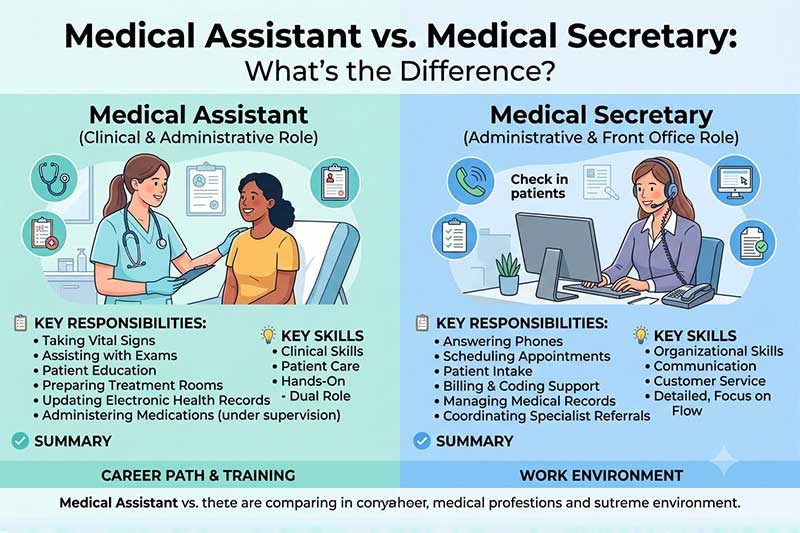
Choosing between a clinical support role and an administrative one in healthcare can feel overwhelming—especially when the job titles sound similar. Clinical support professionals and medical secretaries both keep healthcare facilities running, but their daily responsibilities, required skills, and career paths differ significantly. This guide breaks down each role in detail, compares salaries and education requirements, and helps you figure out which path fits your goals.
Key Takeaways
- Clinical support professionals (often called medical assistants) handle both clinical tasks—like taking vital signs and preparing patients—and administrative duties, making them one of the most versatile roles in healthcare.
- Medical secretaries focus primarily on administrative functions: scheduling, correspondence, records management, and front-desk operations.
- The Bureau of Labor Statistics (BLS) projects 23% employment growth for clinical support professionals from 2023 to 2033, far outpacing average job growth across all occupations.
- Clinical support roles typically require hands-on training or a diploma program, while medical secretary positions may be accessible with a high school diploma and on-the-job training.
- If you prefer patient interaction and clinical work, a diploma program in medical assisting is the faster, more structured path to a rewarding healthcare career.
Both roles are essential to healthcare settings—from private clinics and physician offices to ambulatory surgery centers and mental health facilities. But they serve very different functions. Understanding those differences upfront saves you time, money, and the frustration of training for a role that doesn’t match what you actually want to do every day.
What Does a Clinical Support Professional (Medical Assistant) Do?
A clinical support professional-commonly referred to in the field as a medical assistant-serves as a bridge between patients and physicians. This role combines hands-on patient care with administrative support, which is what makes it uniquely valuable in fast-paced healthcare environments.
Clinical Responsibilities
- Taking and recording vital signs (blood pressure, temperature, pulse, and respiration rate)
- Preparing patients for examinations and procedures
- Administering injections and drawing blood samples
- Performing electrocardiograms (EKGs)
- Assisting physicians during exams
- Collecting and processing lab specimens
- Explaining treatment plans and medication instructions to patients
Administrative Responsibilities
Despite the clinical focus, the role also includes office-based tasks:
- Scheduling patient appointments
- Updating and maintaining electronic health records (EHRs)
- Handling insurance verification and prior authorizations
- Processing billing and medical coding
- Managing patient correspondence
This dual-function nature is what sets the role apart. According to the BLS Occupational Outlook Handbook, employment in this field is projected to grow 23% over the next decade—much faster than average—driven largely by an aging population and the ongoing expansion of outpatient care facilities.
For a closer look at the specific competencies involved, the ATA College blog article 18 Must-Have Medical Assistant Skills offers an in-depth breakdown worth reading before you commit to a program.
What Does a Medical Secretary Do?
Medical secretaries work on the administrative side of healthcare. Their role centers on keeping offices organized and ensuring smooth communication between patients, staff, and healthcare providers—without the clinical component.
Core Responsibilities of a Medical Secretary
- Answering and directing phone calls and emails
- Scheduling and confirming patient appointments
- Managing medical records and filing systems
- Transcribing physician notes and correspondence
- Coordinating referrals and specialist appointments
- Handling billing inquiries and insurance paperwork
- Ordering office supplies and managing inventory
Medical secretaries typically work at front desks or in administrative offices. Their work is critical to patient experience and operational efficiency, but they generally do not interact with patients in a clinical capacity—no taking vitals, no preparing exam rooms, no assisting with procedures.
According to the BLS, medical secretaries and administrative assistants in healthcare settings held approximately 519,000 jobs in recent years. While demand remains steady, growth projections for the role are more modest compared to clinical support professionals.
Medical Assistant vs. Medical Secretary: A Side-by-Side Comparison
Here is a clear, direct comparison of the two roles across the most important decision-making factors:
| Factor | Clinical Support Professional | Medical Secretary |
|---|---|---|
| Patient Interaction | High — direct, hands-on patient care | Low — primarily indirect (scheduling, records) |
| Clinical Tasks | Yes (vitals, injections, EKGs, specimen collection) | No |
| Administrative Tasks | Yes (scheduling, billing, EHRs) | Yes (primary focus) |
| Typical Work Settings | Clinics, hospitals, physician offices, surgery centers | Hospitals, physician offices, insurance companies |
| Education Required | Diploma or associate degree program (8–14 months) | High school diploma; on-the-job training common |
| Certification Available | Yes (NCCT, AAMA, AMT) | Optional (NAHRS, AHIMA) |
| Median Annual Salary (BLS) | ~$42,000 | ~$38,000 |
| Job Growth Projection | 23% (2023–2033) | Moderate/stable |
| Career Advancement | EKG Tech, Health Information Tech, nursing pathways | Office management, health administration |
How Do the Salaries Compare?
Salary is often a deciding factor, and both roles offer competitive pay for the level of training required.
Clinical support professionals earn a median annual wage of approximately $42,000, according to the BLS, with higher earnings in specialty practices, surgical centers, and larger metropolitan areas. Those who pursue national certification—through organizations like the NCCT (National Center for Competency Testing)—or expand into EKG technician roles can command higher salaries over time.
Medical secretaries earn a median annual wage of approximately $38,000. Salaries increase with experience and in settings like large hospital systems or specialty medical offices. Moving into health administration or office management can also push earnings higher over time.
The salary gap may seem modest, but clinical support professionals typically benefit from faster job growth, more defined training pathways, and more opportunities to specialize or advance within a clinical career track.
What Education and Training Does Each Role Require?
Training for Clinical Support Professionals
This is where the two paths diverge most clearly. Clinical support professionals need formal training to perform clinical procedures safely and competently. A diploma program—like the one offered at ATA College—covers:
- Anatomy and Physiology
- Medical Terminology
- Pharmacology
- Clinical Procedures (including injections, specimen collection, and EKGs)
- Medical Office Administration
- Medical Insurance and Coding
- Laboratory Procedures
ATA College’s diploma program can be completed in as little as 8 months, with morning and evening class options available for working students. After completing the diploma, students can continue into an Associate of Applied Science (AAS) program in an additional six months—earning credits toward national certification exams through the NCCT.
Hands-on externship training is built into the program, giving graduates real-world experience before they enter the workforce.
Training for Medical Secretaries
Medical secretaries generally do not require a specialized diploma, though some employers prefer candidates with formal training in medical office administration, healthcare management, or health information technology. Community college certificate programs, on-the-job training, and professional development courses are all common routes into the role.
Optional certifications—such as those offered through the National Association for Healthcare Recruitment and Support (NAHRS) or the American Health Information Management Association (AHIMA)—can strengthen a résumé but are not typically required for entry-level positions.
Which Role Is the Right Fit for You?
The answer depends on what you want your workday to look like.
Choose a clinical support role if you:
- Want to work directly with patients
- Are comfortable with clinical procedures and hands-on tasks
- Want faster job growth and more structured career advancement
- Are willing to complete a short diploma or degree program
- Are interested in eventually expanding into EKG technology, health information, or nursing
Choose a medical secretary role if you:
- Prefer a desk-based, administrative environment
- Are organized, detail-oriented, and enjoy systems and scheduling
- Want to enter the workforce quickly with minimal formal training
- Are interested in moving into health administration or office management
Neither path is lesser. Both are essential to functioning healthcare facilities. The real question is where you see yourself—behind a reception desk or beside a patient exam table.
If you are drawn to patient care but want to enter the healthcare field quickly, the clinical support path—with a structured diploma program—is the more direct route. As explored in the ATA College blog post 5 Reasons to Choose a Career-Focused Education, targeted programs offer faster outcomes than traditional degree paths, often with higher employment rates in the specific field you train for.
Start Your Healthcare Career at ATA College
ATA College, located in El Cajon, San Diego, has been preparing students for entry-level healthcare careers since 1996. The 8-month diploma program in medical assisting covers both clinical and administrative skills, ensuring graduates are genuinely job-ready—not just theoretically trained.
Financial aid is available for those who qualify, and VA benefits are accepted for eligible veterans. Career services, including job placement assistance, resume development, and career workshops, are included as part of the program.
Telehealth is also reshaping what this role looks like in practice—something the ATA College blog explores in depth in Medical Assistants in Telehealth: Thriving in Digital Healthcare. Clinical professionals today need to be as comfortable with digital platforms as they are with clinical instruments.
The Bottom Line: Both Roles Matter, But Only One Fits Your Goals
Healthcare facilities cannot operate without either clinical support professionals or skilled medical secretaries. But these two careers ask very different things of the people in them. One demands clinical competency, direct patient contact, and technical training. The other requires organizational precision, strong communication, and comfort with administrative systems.
Take time to reflect on what kind of workday energizes you. Then pursue the training path that actually prepares you for it. If the clinical route appeals to you, request program information from ATA College and find out how quickly you could be workforce-ready.
Frequently Asked Questions
What is the main difference between a medical assistant and a medical secretary?
A clinical support professional (medical assistant) performs both clinical tasks—like taking vital signs, administering injections, and assisting during exams—and administrative duties. A medical secretary focuses exclusively on administrative functions, such as scheduling, correspondence, and records management, with no direct clinical patient care.
Do medical assistants earn more than medical secretaries?
Yes, generally. The BLS reports a median annual salary of approximately $42,000 for clinical support professionals and approximately $38,000 for medical secretaries. Salary varies by location, experience, and work setting.
How long does it take to become a medical assistant?
A diploma program—such as the one at ATA College in El Cajon—can be completed in as little as 8 months. Students who continue to an Associate of Applied Science (AAS) degree can complete the additional coursework in roughly 6 more months.
Is medical assisting a good career choice in 2026?
Yes. The BLS projects 23% job growth for clinical support professionals over the next decade, which is significantly faster than the national average for all occupations. Demand is being driven by an aging population and the expansion of outpatient and specialty care facilities.
Can a medical secretary transition into a clinical role later?
It is possible, but it requires additional formal training. Clinical tasks require hands-on instruction, externship experience, and often formal certification. A medical secretary interested in transitioning to a clinical role would typically need to complete a diploma or associate degree program.
Do I need certification to work as a medical secretary?
Certification is not required for most medical secretary positions, though it can be advantageous. For clinical support professionals, national certification through organizations like the NCCT is strongly recommended and often preferred by employers.
What work settings hire both medical assistants and medical secretaries?
Both roles are commonly found in physician offices, hospital outpatient departments, clinics, ambulatory surgery centers, and specialty practices. Clinical support professionals are more commonly placed in hands-on clinical environments, while medical secretaries are more frequently positioned in administrative offices.