
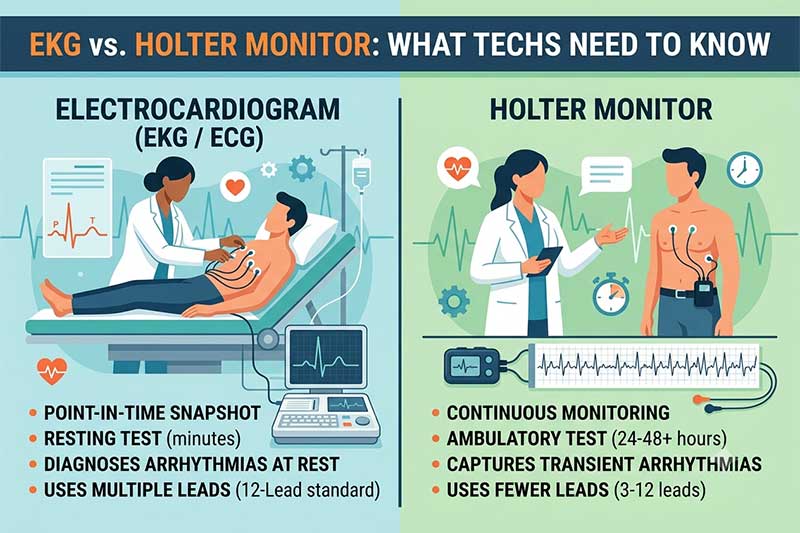
Electrocardiograms (EKGs) and Holter monitors are essential diagnostic tools used by healthcare professionals to detect cardiac abnormalities, but the two devices serve entirely different clinical purposes based on the duration of monitoring required. While an EKG captures a quick, 10-second snapshot of the heart’s electrical activity in a clinical setting, a Holter monitor records continuous data over 24 to 48 hours to catch intermittent irregular heartbeats. This guide breaks down the specific applications of each cardiac device, the distinct responsibilities of cardiovascular technicians, and how aspiring professionals can master these vital healthcare technologies.
Key Takeaways
- An EKG provides an immediate, brief reading of cardiac electrical activity, making the device ideal for diagnosing acute heart issues like active arrhythmias or myocardial infarctions.
- A Holter monitor tracks heart rhythms continuously for at least 24 hours, which allows cardiologists to diagnose transient symptoms (like palpitations or dizziness) that a standard EKG frequently misses.
- Healthcare technicians must understand the precise anatomical placement of electrodes for both devices to ensure accurate, artifact-free diagnostic data collection.
- The demand for skilled diagnostic professionals is rising, making specialized training programs a strategic entry point into emerging healthcare careers.
What is the main difference between an EKG and a Holter monitor?
The primary difference between an EKG and a Holter monitor is the duration of time each device spends recording the heart’s electrical signals. A standard resting EKG records heart activity for roughly 10 seconds while the patient lies still in a clinical setting. A Holter monitor is a portable, wearable device that continuously records the patient’s heart activity for 24 to 48 hours as the patient goes about their normal daily routine.
Cardiologists use a standard 12-lead EKG to establish a baseline of a patient’s heart health or to diagnose immediate, severe conditions during an emergency. Because the EKG test is extremely brief, the device cannot detect sporadic cardiac events. For patients experiencing unexplained fainting spells, intermittent chest pain, or irregular heartbeats that come and go, physicians rely on the extended data collection of a Holter monitor. By wearing the Holter monitor during sleep, exercise, and daily stress, the patient provides the cardiologist with a comprehensive picture of how the heart behaves under various real-world conditions.
How does an EKG test work in a clinical setting?
An EKG test measures the electrical impulses that trigger heart muscle contractions and translates them into a visual graph for immediate medical review. During the procedure, an EKG technician places 10 adhesive electrodes on specific locations across the patient’s chest, arms, and legs. These 10 electrodes generate 12 distinct “leads” or viewpoints of the heart’s electrical activity.
The technician must ensure the patient remains perfectly still, as any muscle movement can create artifacts that obscure the final reading. According to the American Heart Association (AHA), the entire EKG process takes about three minutes from setup to completion, making it one of the fastest and most noninvasive ways to detect abnormal heart rhythms, chamber enlargement, or reduced blood flow to the heart muscle. Technicians immediately provide the resulting waveform graph to a physician for interpretation.
How does a Holter monitor track heart activity over time?
A Holter monitor continuously records a patient’s electrocardiogram data onto a small, battery-operated device worn on a strap around the neck or waist. An EKG technician attaches three to seven electrodes to the patient’s chest and connects them to the recording device via lead wires. The monitor then captures every single heartbeat over the prescribed 24- to 48-hour period.
Patients receive specific instructions from the technician before leaving the clinic. The patient must keep the monitor dry, avoiding showers or swimming, and must meticulously record any symptoms in a physical diary. If the patient feels dizzy or experiences palpitations at 2:15 PM, they write that exact time and symptom in the diary. When the patient returns the Holter monitor to the clinic, the technician downloads the data. The cardiologist then cross-references the patient’s symptom diary with the digital Holter monitor data to determine if a cardiac arrhythmia caused the recorded symptoms.
When should a doctor prescribe an EKG versus a Holter monitor?
Physicians choose between an EKG and a Holter monitor based on the frequency and severity of the patient’s symptoms. A doctor will order an EKG for immediate diagnostic needs, such as a patient arriving at the emergency room with active chest pain. A doctor will order a Holter monitor for transient symptoms that require long-term observation.
Choose an EKG if immediate diagnosis is required, the patient is currently experiencing severe symptoms, or the physician needs a routine preoperative cardiac baseline. Choose a Holter monitor if the patient experiences unexplained dizziness or intermittent palpitations, or if the physician needs to evaluate the long-term effectiveness of a newly prescribed antiarrhythmic medication.
The table below outlines the core differences between the two cardiac diagnostic tools:
| Feature | Standard 12-Lead EKG | Holter Monitor |
|---|---|---|
| Duration of Test | 10 seconds of recording time | 24 to 48 hours of continuous recording |
| Device Portability | Stationary clinical machine | Wearable, battery-operated portable device |
| Number of Electrodes | 10 electrodes | 3 to 7 electrodes |
| Primary Clinical Use | Immediate diagnosis of acute heart issues | Catching intermittent, unpredictable arrhythmias |
| Patient Activity | Resting, lying perfectly still on an exam table | Normal daily activities (excluding water exposure) |
How do technicians prepare patients for these cardiac tests?
EKG technicians are directly responsible for preparing patients physically and educating them about the diagnostic process. Proper preparation ensures clear electrical signals and accurate test results.
First, the technician cleans the specific electrode sites on the patient’s skin using an alcohol wipe to remove natural oils and lotions. If the patient has significant body hair on the chest, the technician may need to shave small patches to ensure the adhesive electrodes make direct contact with the skin. For a standard EKG, the technician instructs the patient to lie flat, breathe normally, and refrain from talking or moving.
For a Holter monitor application, the technician must secure the electrodes firmly with medical tape to prevent them from detaching during the patient’s daily activities. The technician also spends time educating the patient on how to log activities and symptoms in the provided diary. Mastery of these hands-on skills requires dedicated education. Enrolling in specialized EKG Technician programs equips students with the clinical competencies needed to perform these tasks flawlessly in a fast-paced medical environment.
Why is specialized education crucial for cardiovascular technology careers?
Diagnostic equipment is highly sensitive, and incorrect electrode placement can lead to false readings, misdiagnoses, and improper medical treatments. Because cardiologists rely entirely on the data gathered by healthcare technicians, these technicians must possess a deep, formalized understanding of cardiac anatomy, electrophysiology, and patient care protocols.
There are many reasons to choose a career-focused education when entering the medical field. Vocational colleges and technical schools provide students with hands-on practice using actual clinical equipment. Rather than relying solely on textbook theory, students practice attaching leads, troubleshooting artifacts on EKG readouts, and interacting with patients in simulated clinical environments. According to the U.S. Bureau of Labor Statistics, employers strongly prefer hiring technicians who have completed accredited programs and hold professional certifications.
Launching Your Career in Diagnostic Technology
Both the standard EKG and the Holter monitor are indispensable tools in the fight against cardiovascular disease. While the devices operate on the same fundamental principles of measuring cardiac electrical impulses, their differing timelines provide physicians with complementary data. Mastering the application, troubleshooting, and patient management associated with both devices makes an EKG technician an invaluable asset to any hospital or cardiology clinic.
If you are ready to master these vital diagnostic tools, explore certified training programs that combine rigorous classroom instruction with practical clinical experience.
Frequently Asked Questions (FAQ)
How much does an EKG test cost compared to a Holter monitor?
A standard EKG is generally inexpensive, typically costing between $50 and $100 without insurance, because the test is brief. A Holter monitor is more expensive, often ranging from $300 to $800, because the device requires extended use, specialized equipment rental, and more complex data analysis by the cardiologist.
How long does it take to get the results from a Holter monitor?
Cardiologists generally provide Holter monitor results within one to two weeks after the patient returns the device. The technician must first download the extensive 24- to 48-hour data log, and the cardiologist must carefully review the digital readout alongside the patient’s manual symptom diary.
What are the risks of wearing a Holter monitor?
A Holter monitor is a non-invasive, completely safe diagnostic tool with no serious medical risks. The only common side effect is mild skin irritation or redness at the sites where the adhesive electrodes attach to the chest, which resolves quickly after the technician removes the device.
Are there alternatives to a Holter monitor for long-term tracking?
Yes, cardiologists can prescribe event monitors or implantable loop recorders for patients who experience cardiac symptoms very infrequently. Event monitors are worn for up to 30 days and record only when the patient activates the device, while implantable loop recorders are placed under the skin to continuously monitor the heart for up to 3 years.
Who is best suited for a career as an EKG technician?
A career as an EKG technician is ideal for detail-oriented individuals with strong communication skills and a deep empathy for patients. Successful technicians must combine technical proficiency in operating sensitive diagnostic equipment with the bedside manner required to calm anxious patients during stressful medical exams.