
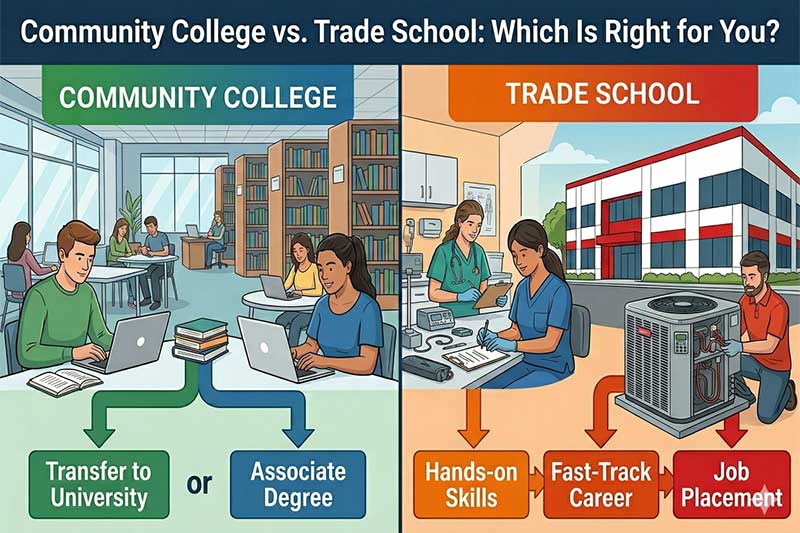
Deciding between a community college and a trade school represents a major crossroad for high school graduates and career changers alike. Both educational paths offer valuable training, but community colleges and trade schools cater to distinctly different career goals, budgets, and timelines. This guide breaks down the financial investments, program lengths, and job prospects associated with each option so students can make an informed decision about their future education.
Key Takeaways
- Trade schools focus exclusively on career-specific skills, allowing students to enter the workforce in a matter of months rather than years.
- Community colleges provide a broader educational foundation, often serving as a stepping stone for students planning to transfer to a four-year university.
- The total financial cost of a trade school program is generally lower than a two-year associate degree due to the shorter duration of technical programs.
- Choosing the right path depends entirely on specific career objectives, timeline requirements, and personal learning preferences.
What are the main differences between a community college and a trade school?
The primary difference between a community college and a trade school lies in the curriculum focus and ultimate educational goal. Trade schools provide hands-on, highly specialized training designed specifically to prepare students for a distinct occupation. Community colleges require students to complete general education courses alongside major-specific classes, resulting in a broader academic experience.
Trade schools eliminate courses that do not directly apply to a student’s chosen profession. A student studying to become a medical assistant at a technical school will only take classes related to healthcare, anatomy, and patient care. Conversely, a student pursuing a similar healthcare associate degree at a community college must also complete credits in history, mathematics, and literature.
| Feature | Trade School (Vocational School) | Community College |
|---|---|---|
| Primary Goal | Direct career preparation and certification | Associate degree or university transfer |
| Curriculum Focus | Hands-on, industry-specific skills | Broad academics plus major requirements |
| Program Length | 3 to 18 months | 2 to 3 years |
| Class Formats | Practical labs and technical training | Traditional lectures and academic seminars |
How much does a community college cost compared to a trade school?
A community college typically costs more in total, including tuition and living expenses, than a trade school because associate degree programs take significantly longer to complete. While the per-credit cost at a local community college might appear low, the requirement to complete 60 or more credits over two years drives up the total financial investment.
According to data published by the College Board, the average published yearly tuition and fees for a public two-year in-district community college is approximately $3,990. Over two years, this totals nearly $8,000, not accounting for textbooks, housing, or the opportunity cost of being out of the full-time workforce. Trade school programs vary widely in cost depending on the field of study, but the condensed timeline means students pay for fewer semesters and start earning a professional salary much sooner. Students focused on minimizing long-term debt often explore 5 reasons to choose a career-focused education to better understand the financial benefits of accelerated training.
Which educational path leads to faster employment?
Trade schools lead to faster employment because vocational programs typically last between three and eighteen months, directly aligning with urgent industry hiring needs. Community college associate degrees require at least two full years of continuous study to reach graduation.
Because technical institutions partner closely with local employers, the curriculum at a trade school directly mirrors what hiring managers need immediately. Students spend their time practicing on the exact equipment they will use on the job. The Bureau of Labor Statistics frequently reports high demand for technically skilled workers in healthcare, technology, and skilled trades. By removing general education requirements, trade schools accelerate a student’s entry into these high-growth sectors.
Who should choose a trade school over a community college?
Choose a trade school if entering the workforce quickly and avoiding unnecessary academic coursework matters more than earning a broad college degree. Trade schools are an ideal fit for individuals who learn best through hands-on practice rather than traditional textbook study.
Alternatively, choose a community college if your long-term goal requires a bachelor’s degree or if you remain undecided about a specific career path. Community colleges allow students to explore different subjects before committing to a major. However, for those with a clear vision of their future occupation, technical training provides a direct, efficient route to professional success. Prospective students debating these options often research why vocational school could be your best next step to evaluate their personal alignment with technical training.
Taking the Next Step Toward Your Career Goals
Ultimately, neither a community college nor a trade school is universally superior; the best option depends on your unique career objectives and learning style. Evaluating the specific requirements of your desired profession is the most effective way to choose the right educational institution.
If you thrive in practical, hands-on environments and want to launch your career as quickly as possible, technical education offers a streamlined, efficient solution. Students ready to take action can discover how ATA College prepares you for the workforce by exploring accelerated programs in healthcare, technology, and criminal justice. Connecting with an admissions advisor can provide the specific program details necessary to turn your professional ambitions into a tangible reality.
Frequently Asked Questions
What are the main alternatives to attending a community college?
The most common alternatives to attending a community college include enrolling in a trade school, entering a registered apprenticeship program, or joining the military. Trade schools offer the closest structured educational alternative, focusing specifically on career-ready skills without general education requirements.
Does a trade school degree hold the same value as a community college degree?
A trade school certificate holds immense value within its specific industry, often holding equal or greater weight than a general associate degree for technical roles. Employers in healthcare, HVAC, and software programming prioritize candidates who possess practical, verifiable skills and industry-recognized certifications over those with purely academic backgrounds.
How long does it take to complete a trade school program?
Most trade school programs take between three and eighteen months to complete. The exact timeline depends heavily on the specific career field; a certified nursing assistant (CNA) program might conclude in a matter of weeks, while a comprehensive software development diploma requires several months of intensive study.
Can trade school credits transfer to a community college later?
Trade school credits generally do not transfer to community colleges or four-year universities because vocational courses lack the broad academic foundation required by traditional degree programs. Students who attend a trade school should do so with the intention of entering the workforce directly rather than pursuing a subsequent academic degree.
What are the financial risks of choosing a community college over a trade school?
The primary financial risk of choosing a community college is the opportunity cost of spending 2 or more years outside the full-time workforce. Additionally, students who change their majors or fail to complete their general education requirements risk accumulating student debt without earning the credential necessary to secure higher-paying employment.