
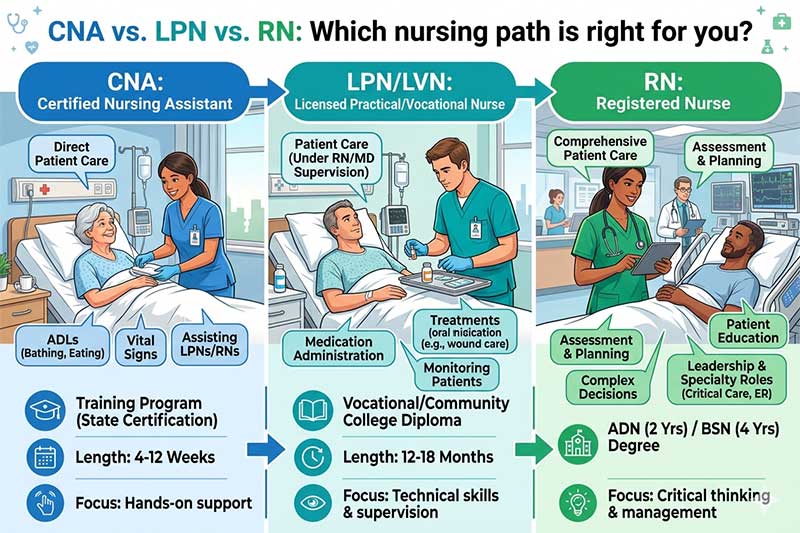
Choosing the right nursing career path depends heavily on your professional goals, educational timeline, and desired level of responsibility in patient care. This comprehensive guide compares Certified Nursing Assistants (CNAs), Licensed Practical Nurses (LPNs), and Registered Nurses (RNs) to help you understand the core differences in their daily duties, earning potential, and required training. By evaluating the specific demands of each healthcare role, you can make an informed decision about which medical profession aligns perfectly with your future.
Answer-first summary: The primary difference between a Certified Nursing Assistant (CNA), a Licensed Practical Nurse (LPN), and a Registered Nurse (RN) lies in their scope of medical practice and necessary education. Certified Nursing Assistants provide basic daily patient care after a few weeks of training. Licensed Practical Nurses administer medications and treatments with about one year of education. Registered Nurses manage complex patient care plans and oversee other nursing staff, requiring a two- to four-year college degree.
Key Takeaways
- Certified Nursing Assistants offer entry-level patient support and require the shortest training period, making the CNA role ideal for quickly entering the healthcare field.
- Licensed Practical Nurses handle more advanced clinical tasks than CNAs, such as inserting catheters and monitoring vital signs, which requires completing a state-approved diploma or certificate program.
- Registered Nurses hold the highest level of clinical responsibility among these three paths, overseeing LPNs and CNAs while requiring an Associate Degree in Nursing (ADN) or a Bachelor of Science in Nursing (BSN).
- Your ultimate career choice depends on whether you prioritize rapid entry into the workforce, a balance of clinical duties and shorter schooling, or maximum earning potential with leadership opportunities.
What is a Certified Nursing Assistant (CNA) and what do they do?
A Certified Nursing Assistant (CNA) provides fundamental, hands-on care to patients in hospitals, nursing homes, and residential care facilities under the supervision of nursing staff. Certified Nursing Assistants directly assist patients with activities of daily living, ensuring patients remain clean, comfortable, and safe.
Daily duties for a Certified Nursing Assistant include bathing and dressing patients, serving meals and assisting with meals, repositioning bedridden patients to prevent bedsores, and measuring basic vital signs such as temperature and blood pressure. Because CNAs spend extensive time directly interacting with patients, they often serve as the primary observers who report critical changes in a patient’s physical or mental condition to the supervising nursing staff.
If you want to understand the daily reality of this position, exploring a day in the life of a CNA can provide valuable perspective. Furthermore, becoming a Certified Nursing Assistant serves as an excellent stepping stone for individuals planning to advance to LPN or RN roles later. You can learn more about this foundational role by reading a comprehensive CNA job description and career guide.
What are the responsibilities of a Licensed Practical Nurse (LPN)?
A Licensed Practical Nurse (LPN)—often referred to as a Licensed Vocational Nurse (LVN) in certain states like California and Texas—provides basic medical care under the direct supervision of Registered Nurses and attending physicians. The Licensed Practical Nurse assumes more clinical responsibility than a CNA but handles less complex medical decisions than a Registered Nurse.
The core responsibilities of a Licensed Practical Nurse include administering basic patient care, changing bandages, inserting urinary catheters, monitoring blood pressure, and maintaining detailed patient health records. In many states, Licensed Practical Nurses can also administer specific medications and start intravenous (IV) drips, though state nursing boards heavily regulate these specific tasks. Licensed Practical Nurses frequently work in nursing care facilities, home healthcare environments, and physicians’ offices, providing essential middle-tier healthcare support.
What does a Registered Nurse (RN) do in daily medical practice?
A Registered Nurse (RN) coordinates comprehensive patient care, educates patients about various health conditions, and provides critical advice and emotional support to patients and their family members. Registered Nurses hold the highest level of authority among these three credentials and regularly oversee the daily work of LPNs and CNAs.
In daily medical practice, a Registered Nurse assesses patient conditions, records detailed medical histories, administers complex medications, and operates advanced medical equipment. Registered Nurses also collaborate directly with physicians to design, implement, and evaluate patient care plans. Because of their extensive training, Registered Nurses can specialize in specific medical fields such as pediatrics, oncology, or critical care. This level of specialization makes the Registered Nurse an indispensable leader within hospital environments, outpatient clinics, and emergency rooms.
How do the education requirements for CNAs, LPNs, and RNs compare?
Education requirements in the nursing field scale directly with the level of medical responsibility, ranging from four to eight weeks for a Certified Nursing Assistant to four years for a Registered Nurse with a bachelor’s degree.
To help clarify the educational pathways, the table below outlines the basic requirements, average training times, and scopes of practice for each nursing role:
| Nursing Role | Education Required | Average Training Time | Scope of Practice |
|---|---|---|---|
| Certified Nursing Assistant (CNA) | State-approved certificate program | 4 to 12 weeks | Basic patient comfort, hygiene, feeding, and vital signs monitoring. |
| Licensed Practical Nurse (LPN) | State-approved practical nursing diploma or certificate | 12 to 18 months | Medication administration, wound care, catheter insertion, and health record maintenance. |
| Registered Nurse (RN) | Associate Degree in Nursing (ADN) or Bachelor of Science in Nursing (BSN) | 2 to 4 years | Care plan creation, complex medication administration, diagnostic testing, and team leadership. |
According to the U.S. Bureau of Labor Statistics (BLS), higher educational investments in healthcare directly correlate with higher median salaries and broader employment opportunities. While a Certified Nursing Assistant requires the least amount of financial and time investment, the Registered Nurse enjoys the highest salary ceiling and the most robust job security.
Which nursing career path should you choose based on your professional goals?
Selecting the ideal nursing career path requires aligning your educational bandwidth, financial resources, and long-term career aspirations. Each level of nursing provides distinct advantages depending on your specific life circumstances.
Choose the Certified Nursing Assistant (CNA) path if you want to enter the workforce rapidly. The CNA route is perfect for individuals who want to gain immediate foundational patient care experience without committing to years of expensive college tuition.
Choose the Licensed Practical Nurse (LPN) path if you want to perform clinical duties but prefer to complete your schooling in approximately one year. The LPN role strikes a balance between advanced patient care responsibility and an accelerated entry into the professional medical field.
Choose the Registered Nurse (RN) path if you seek high earning potential, leadership roles, and clinical specialization options. While the RN path requires two to four years of rigorous college education, it rewards graduates with maximum autonomy and career mobility.
Regardless of which path you select, securing a quality education is paramount. There are numerous reasons to choose a career-focused education that provides hands-on clinical training, ensuring you are fully prepared to pass your state certification or licensure exams.
How can you start your healthcare education journey today?
The healthcare industry desperately needs compassionate, dedicated professionals at every level of patient care. Whether you decide to start as a Certified Nursing Assistant, pursue a diploma to become a Licensed Practical Nurse, or enroll in a degree program to become a Registered Nurse, your contribution to patient health will be invaluable.
To take the next step, evaluate your local state requirements for certification or licensure. Research accredited programs that fit your schedule and financial budget. ATA College offers specialized, career-focused healthcare programs designed to move students smoothly from the classroom to the clinical setting. Reach out to an admissions advisor today to discuss how you can begin building a rewarding career in the nursing field.
Frequently asked questions about nursing careers
Can a Certified Nursing Assistant (CNA) become a Registered Nurse (RN)?
Yes, a Certified Nursing Assistant can become a Registered Nurse. Many CNAs use their entry-level position to gain clinical experience and earn income while attending nursing school to complete an Associate Degree in Nursing (ADN) or a Bachelor of Science in Nursing (BSN). Some nursing schools even offer specific bridge programs to accelerate this transition.
How much does a Licensed Practical Nurse (LPN) earn compared to a Registered Nurse (RN)?
A Licensed Practical Nurse generally earns less than a Registered Nurse due to differences in education and clinical responsibility. According to recent data from the U.S. Bureau of Labor Statistics, Registered Nurses consistently command higher median salaries than LPNs. However, LPNs still earn a highly competitive wage, especially in specialized nursing care facilities and home health environments.
Are Registered Nurses (RNs) in high demand in the United States?
Yes, Registered Nurses remain in extremely high demand across the United States. Factors such as an aging population, an increase in chronic health conditions, and the retirement of older nurses have created a substantial ongoing need for educated Registered Nurses in hospitals, clinics, and community healthcare centers.