
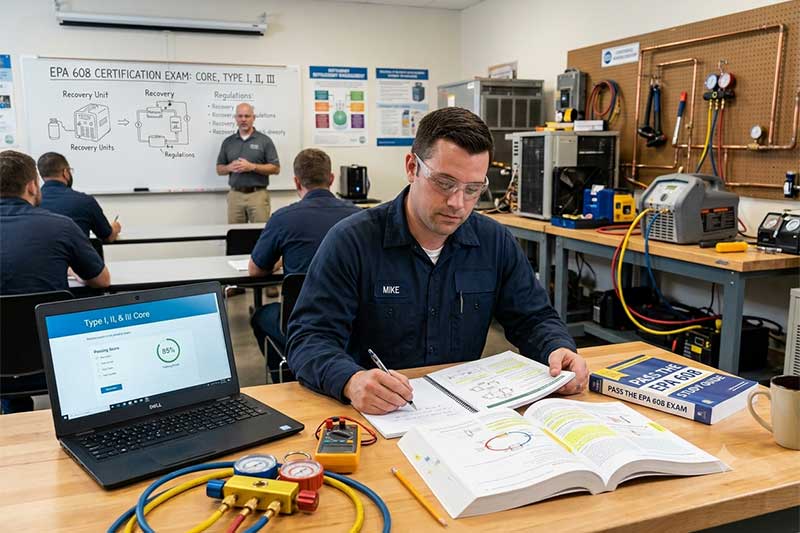
If you’re training to become an HVAC technician, the EPA 608 certification isn’t optional—it’s the law. Anyone who purchases or handles refrigerants regulated under Section 608 of the Clean Air Act must hold a valid EPA 608 certification. The exam covers refrigerant handling, environmental regulations, and system-specific knowledge across four certification types. This guide breaks down everything you need to know: what the exam tests, how each section is structured, how to study effectively, and what to expect on test day—so you can walk in confident and walk out certified.
Key Takeaways
- The EPA 608 exam is required by federal law for anyone who purchases or handles refrigerants in HVAC systems.
- The exam is divided into four sections: Core, Type I (small appliances), Type II (high-pressure systems), and Type III (low-pressure systems).
- Passing each section requires a score of 70% or higher.
- Studying with an EPA 608 practice test is one of the most effective preparation strategies.
- Universal certification—earned by passing all four sections—opens the most career opportunities for HVAC technicians.
What Is the EPA 608 Certification, and Who Needs It?
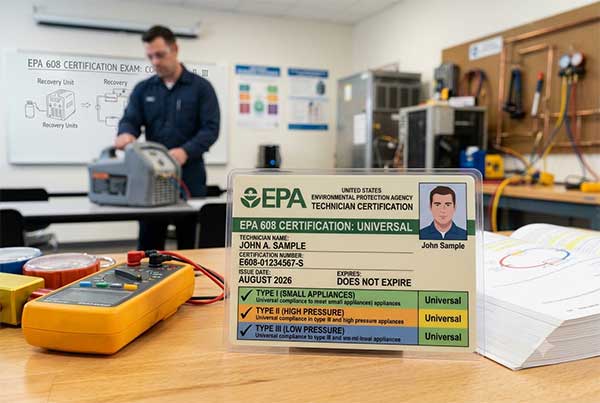
The EPA 608 certification is a federally mandated credential that authorizes HVAC technicians to purchase and handle refrigerants. It is administered under Section 608 of the Clean Air Act and enforced by the U.S. Environmental Protection Agency (EPA).
Without this certification, technicians cannot legally purchase regulated refrigerants, which effectively bars them from performing core HVAC service work. Employers hiring entry-level technicians typically require it as a baseline credential before a technician can work independently in the field.
There are four certification types under EPA 608:
| Certification Type | Covers |
|---|---|
| Core | Required for all candidates; covers environmental regulations and refrigerant safety |
| Type I | Small appliances (5 lbs. or less of refrigerant, factory-charged) |
| Type II | High-pressure and very high-pressure systems (e.g., R-22, R-410A) |
| Type III | Low-pressure systems (e.g., centrifugal chillers using R-11 or R-123) |
| Universal | All of the above—the most comprehensive and career-relevant credential |
Most entry-level HVAC technicians pursue Universal certification to maximize their employability. If your goal is residential and light commercial work, passing the Core, Type I, and Type II sections will cover the vast majority of systems you’ll encounter.
What Does the EPA 608 Exam Cover?
Core Section: The Foundation of Every Certification Type
Every candidate must pass the Core section, regardless of which type of certification they’re pursuing. This section focuses on:
- Environmental regulations: The Montreal Protocol, Clean Air Act Section 608, and refrigerant phase-out requirements
- Refrigerant safety: Toxicity, flammability, proper handling, and personal protective equipment (PPE)
- Ozone depletion and global warming potential (GWP): Understanding CFCs, HCFCs, HFCs, and their environmental impact
- Recovery, recycling, and reclaiming refrigerants: Legal requirements and proper procedures
The Core section contains 25 questions, and you must answer at least 18 correctly (72%) to pass.
Type I: Small Appliances
Type I covers systems with 5 pounds or less of refrigerant that are factory-charged and hermetically sealed—think household refrigerators, window air conditioners, and water coolers. Key topics include:
- Recovery techniques specific to small appliances
- Safe disposal of small appliances
- System-specific leak detection and repair
Type II: High-Pressure Systems
Type II is the most commonly tested section for HVAC technicians focused on residential and commercial work. It covers high-pressure refrigerants like R-22 and R-410A, which are found in split systems, heat pumps, and rooftop units. Topics include:
- Recovery, recycling, and recharging procedures
- Pressure-enthalpy relationships
- Leak testing and evacuation procedures
- Refrigerant cylinder safety and handling
Type III: Low-Pressure Systems
Type III focuses on centrifugal chiller systems that use low-pressure refrigerants such as R-11, R-113, and R-123. These systems operate under reduced pressure, which significantly changes leak detection and recovery procedures. This section is more relevant to commercial and industrial technicians than to those entering residential HVAC.
How Is the EPA 608 Exam Administered?
The EPA 608 exam is not administered directly by the federal government. Instead, the EPA approves third-party organizations to develop and administer the exam. Common approved testing organizations include ESCO Institute and HVAC Excellence.
Here’s what to expect on exam day:
- Format: Multiple-choice written exam
- Passing score: 70% on each section attempted
- Duration: Typically 2–3 hours for all four sections
- Open book option: Some proctored formats allow reference materials, but this varies by test provider
- Retaking: Candidates who fail a section may retake it; policies on retake fees and waiting periods depend on the testing provider
- Certification: Upon passing, candidates receive a certification card that does not expire
Because the certification doesn’t expire, getting it right early in your training pays dividends throughout your entire career.
How to Study for the EPA 608 Certification Exam
Start with an EPA 608 Study Guide
A dedicated EPA 608 study guide organizes the material by section and explains the underlying concepts—not just the answers. Look for guides that cover all four sections, include practice questions, and explain why wrong answers are wrong. Understanding the reasoning behind correct answers matters more than memorizing isolated facts.
The ESCO Institute publishes widely used prep materials aligned with its approved exam content. Many HVAC training programs, including those at trade schools, integrate EPA 608 prep directly into their curriculum.
Use EPA 608 Practice Tests Consistently
Practice tests are the single most effective study tool. They familiarize you with question phrasing, flag weak areas before test day, and build confidence. Aim to complete multiple practice exams under timed conditions before sitting for the real test.
When reviewing practice test results, focus on question categories where you scored below 80%. These are your priority areas. Common weak spots for first-time test-takers include:
- Refrigerant recovery equipment requirements
- Pressure-temperature relationships for specific refrigerants
- Regulatory thresholds (e.g., de minimis release limits)
Understand Refrigerant Types and Their Properties
Much of the exam—particularly the Core and Type II sections—requires you to understand the physical and environmental properties of different refrigerants. Flashcards work well here. Focus on:
- Boiling points and operating pressures for common refrigerants (R-22, R-410A, R-134a, R-11)
- ODP (ozone depletion potential) and GWP values
- Regulatory status (which refrigerants are being phased out and why)
Know the Legal Requirements Cold
Regulatory questions appear throughout every section. The EPA doesn’t just want technicians who know how to handle refrigerants—it wants technicians who know the rules. Review:
- Venting prohibitions and their exceptions
- Refrigerant purchase requirements for certified vs. non-certified individuals
- Record-keeping obligations for systems with 50 or more pounds of refrigerant
- Safe disposal requirements under 40 CFR Part 82
Build a Study Schedule
Spreading your study over two to four weeks tends to produce better retention than cramming. A practical schedule might look like this:
- Week 1: Core section—regulations, ozone science, safety
- Week 2: Type II—high-pressure systems, pressure-enthalpy, recovery equipment
- Week 3: Type I and Type III—small appliances and low-pressure systems
- Week 4: Full practice exams, targeted review of weak areas
If your HVAC training program covers EPA 608 content in class, align your independent study with what’s being taught each week.
What HVAC Technicians Often Get Wrong on the Exam
Even well-prepared candidates can stumble on a few predictable problem areas. Watch out for these:
- Confusing refrigerant recovery with recycling and reclaiming: These are three distinct processes with different definitions under EPA regulations. Recovery means removing refrigerant from a system. Recycling means cleaning it for reuse on-site. Reclaiming means sending it to a certified facility to restore it to ARI 700 purity standards.
- Misidentifying recovery equipment requirements: Requirements differ depending on whether the equipment was manufactured before or after November 15, 1993.
- Getting tripped up on system types: Type II and Type III systems behave very differently under pressure. A chiller operates below atmospheric pressure, which reverses the direction of a leak and changes your leak detection approach entirely.
- Overlooking de minimis release rules: The EPA permits de minimis releases in some situations, but the thresholds and conditions are specific. Vague answers here tend to get candidates into trouble.
How HVAC Training Prepares You for EPA 608 Success
Passing EPA 608 is much more manageable when you’ve had structured training. A formal HVAC technician program—like the HVAC Technician Program at ATA College—provides hands-on experience with the systems covered on the exam, classroom instruction on refrigerant theory and regulations, and dedicated EPA 608 prep.
Trade school programs have a practical advantage over self-study: instructors can clarify confusing concepts, and hands-on lab work reinforces the procedures that show up on the exam. Understanding how a recovery machine works in person is different from reading about it. For a closer look at the safety knowledge HVAC technicians develop in training, the Essential HVAC Safety Tips Every Technician Needs to Know article from the ATA College blog is a useful complement to EPA 608 study.
What Happens After You Pass?
Once you’ve passed the required sections, you’ll receive a certification card from your testing organization. This credential has no expiration date—once you earn it, it’s yours.
From there, most HVAC technicians move into entry-level positions and continue building their skills on the job. Some pursue additional credentials like NATE certification or state-specific refrigeration licenses, which vary by location.
The HVAC field rewards continuous learning. The introduction of lower-GWP refrigerants, the phase-down of R-410A, and advances in variable refrigerant flow (VRF) technology mean that the industry is always evolving. Technicians who understand the regulatory and technical foundations that EPA 608 covers are better positioned to adapt.
If you’re deciding between a trade school and a community college for your HVAC education, the Community College vs. Trade School: Which Is Right for You? article from ATA College walks through the key differences and helps you figure out which path fits your goals.
Take the Next Step Toward Your HVAC Career
The EPA 608 certification is a clear, achievable milestone—and it’s one of the first major steps in building a skilled trades career. The exam rewards preparation, and with the right study materials, consistent practice testing, and a solid understanding of the underlying concepts, passing on your first attempt is a realistic goal.
ATA College’s HVAC Technician Program is designed to give students both the technical knowledge and the EPA 608 preparation needed to enter the workforce confidently. If you’re ready to take that step, connect with ATA College to learn more about the program and how it can set you up for a successful career in HVAC.
Frequently Asked Questions
How hard is the EPA 608 exam?
The EPA 608 exam is considered moderately difficult. The Core and Type II sections tend to be the most challenging for new technicians because they require an understanding of both regulatory details and refrigerant physics. Candidates who complete a structured HVAC training program and use practice tests consistently typically pass on their first attempt.
How long does it take to study for the EPA 608 certification?
Most candidates study for two to four weeks before taking the exam. Those enrolled in an HVAC training program may cover the material over a longer period as part of coursework, which tends to improve retention.
Can I take the EPA 608 exam online?
Yes. Some EPA-approved testing organizations offer online proctored versions of the exam. Others still require in-person testing at approved sites. Check with your testing provider for current options.
What is Universal certification, and should I get it?
Universal certification means passing all four sections of the EPA 608 exam—Core, Type I, Type II, and Type III. It qualifies you to work on all refrigerant-containing systems. Most employers in residential and commercial HVAC prefer Universal-certified technicians because it demonstrates comprehensive knowledge and eliminates work restrictions.
Does the EPA 608 certification expire?
No. The EPA 608 certification does not expire. Once you pass and receive your certification card, it remains valid for the duration of your career.
What refrigerants does the EPA 608 exam focus on?
The exam covers a range of refrigerants, with the heaviest emphasis on common ones like R-22, R-410A (Type II systems), and R-11/R-123 (Type III systems). Understanding each refrigerant’s pressure-temperature relationships and environmental classification is essential for passing.
What score do I need to pass the EPA 608 exam?
You must score 70% or higher on each section you attempt. With 25 questions per section, that means answering at least 18 questions correctly per section.