Becoming a state-certified nursing assistant in California is one of the fastest routes into a healthcare career—but the process has specific requirements that can feel overwhelming at first glance. This guide breaks down every step clearly, from eligibility requirements and approved training programs to the state competency exam and registry enrollment, so you know exactly what to expect and how to move forward.
Key Takeaways
- California requires candidates to complete a state-approved nursing assistant training program before sitting for the certification exam.
- The California Department of Public Health (CDPH) oversees all nursing assistant certification and registry requirements in the state.
- Training programs in California typically range from 5 to 16 weeks, depending on the school and schedule.
- The state competency exam consists of both a written test and a hands-on skills evaluation.
- After passing the exam, candidates must register with the California Nurse Aide Registry to practice legally.
What Does a Nursing Assistant Actually Do in California?
A nursing assistant provides direct, hands-on patient care under the supervision of licensed nurses. In California, they work across a wide range of healthcare settings, including hospitals, long-term care facilities, assisted living communities, home health agencies, and medical clinics.
Day-to-day responsibilities typically include:
- Assisting patients with bathing, grooming, and mobility
- Monitoring and recording vital signs
- Supporting patients with meals and nutritional needs
- Documenting observations for the nursing team
- Providing emotional support and companionship to patients
Want a closer look at what this role involves daily? Read A Day in the Life of a Nursing Assistant: What to Expect for a realistic picture of the job.
What Are the Basic Eligibility Requirements in California?
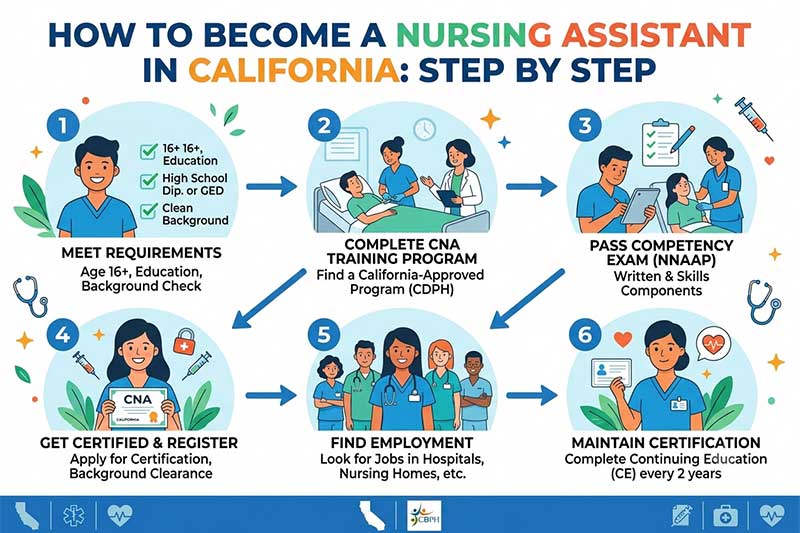
Before applying to any training program, candidates must meet a few baseline requirements set by the state:
- Age: Applicants must be at least 16 years old. Some employers and programs may require candidates to be 18 or older.
- Education: A high school diploma or GED equivalent is typically required, though some programs may accept students who are still enrolled in high school.
- Background Check: California requires a criminal background check through the Department of Justice (DOJ) and the FBI. Certain convictions may disqualify a candidate from certification.
- Physical Health: Candidates must be able to perform the physical demands of patient care, including lifting and standing for extended periods.
- Language: Strong English communication skills are essential for accurate documentation and patient interaction.
Meeting these requirements is the first step. Once confirmed, the next move is enrolling in a state-approved training program.
How Do You Find a State-Approved Nursing Assistant Training Program in California?
California mandates that all nursing assistant training programs be approved by the California Department of Public Health (CDPH). Programs must meet a minimum of 150 hours of combined instruction and clinical training—significantly more than the federal minimum of 75 hours.
When evaluating programs, consider the following:
| Factor | What to Look For |
|---|---|
| Program length | Typically 5–16 weeks |
| Total training hours | 150+ hours (California requirement) |
| Classroom vs. clinical split | Balance of theory and hands-on practice |
| Accreditation | Nationally or regionally accredited institution |
| Schedule flexibility | Day, evening, or weekend options |
| Cost | Ranges from $1,000 to $3,500+ depending on the school |
ATA College in El Cajon, San Diego, offers an accelerated 197-hour program that can be completed in just 5 weeks. The program meets California’s training standards and combines classroom instruction with real-world clinical experience in patient care settings.
Not sure if a career-focused training program is the right path for you? 5 Reasons to Choose a Career-Focused Education outlines why vocational training often outperforms traditional four-year degrees for healthcare entry points.
What Do You Learn During Nursing Assistant Training?
Training programs cover both foundational knowledge and practical patient care skills. A well-structured curriculum typically includes:
- Patient Rights: Understanding HIPAA, dignity, and privacy standards
- Infection Control: Proper hand hygiene, PPE use, and asepsis
- Body Mechanics: Safe lifting and transfer techniques to protect both patient and aide
- Vital Signs: Accurately measuring blood pressure, temperature, pulse, and respiration
- Nutrition Support: Assisting patients with dietary needs and hydration
- Emergency Procedures: Responding to choking, falls, cardiac events, and other urgent situations
- Long-Term and Rehabilitative Care: Supporting patients with chronic conditions or recovery needs
- Observation and Charting: Documenting patient status accurately for the nursing team
The clinical portion places students in real healthcare environments—working alongside professionals in settings like nursing homes and hospitals—before they ever sit for the certification exam.
How Does the California Nursing Assistant Competency Exam Work?
After completing a state-approved training program, candidates must pass the California nursing assistant competency exam, administered by Prometric, the state’s authorized testing vendor.
The exam has two components:
Written (or Oral) Knowledge Test
- 60 multiple-choice questions
- Covers topics from training: patient rights, safety, infection control, body mechanics, and more
- An oral version is available for candidates who have difficulty reading English
Skills Evaluation
- Candidates must perform 5 randomly selected clinical skills in front of a state examiner
- Common skills tested include hand washing, taking vital signs, proper positioning, and patient transfers
- Each skill must be performed correctly and safely to receive a passing score
Both portions must be passed to receive certification. If a candidate fails one section, they can retake that portion without repeating the other. California allows up to three attempts to pass the exam.
What Happens After You Pass the Exam?
Passing the competency exam means you’re ready to apply for placement on the California Nurse Aide Registry—the official state database that employers use to verify certification. Here’s what happens next:
- Registry Enrollment: Prometric automatically submits passing scores to the CDPH. Once processed, your name is added to the California Nurse Aide Registry.
- Certification Card: You’ll receive an official certification card confirming your status.
- Renewal Requirements: California nursing assistant certifications must be renewed every two years. Renewal requires proof of at least 48 hours of paid nursing assistant work during that period.
- Continuing Education: Some employers and facilities may require additional continuing education beyond state minimums.
What Are the Career and Salary Prospects for Nursing Assistants in California?
California is one of the highest-paying states for nursing assistants in the country. According to the U.S. Bureau of Labor Statistics, nursing assistants nationally earn a median annual wage of around $38,000—but California wages frequently exceed this figure due to cost of living and high demand.
Common employment settings in California include:
- Skilled nursing facilities and nursing homes
- Acute care hospitals
- Assisted living and memory care communities
- Home health agencies
- Rehabilitation centers
- Veterans’ care facilities
California’s aging population continues to drive demand for qualified patient care professionals. The BLS projects steady employment growth in this sector through 2032, making it a reliable pathway into healthcare.
Is Nursing Assistant Certification a Pathway to Further Healthcare Careers?
For many professionals, this certification is the starting point—not the finish line. Working as a nursing assistant provides direct patient care experience that strengthens applications for nursing programs, medical assisting roles, and health information technology positions.
Common advancement paths include:
- Licensed Vocational Nurse (LVN)
- Registered Nurse (RN)
- Medical Assistant
- Home Health Aide (HHA)
- Electrocardiogram (EKG) Technician
Curious about how this role compares to other nursing credentials? Explore Which Nursing Path Is Right for You? for a side-by-side breakdown of nursing assistant, LPN, and RN roles.
Start Your Healthcare Career in California
The path to becoming a nursing assistant in California is structured and achievable—even on a tight timeline. Meet the eligibility requirements, complete an approved training program, pass the state competency exam, and register with the California Nurse Aide Registry. That’s the full process.
ATA College’s 5-week, 197-hour program in El Cajon, San Diego is built for people who want to move fast without cutting corners. With a tuition of $2,995 and flexible scheduling options, it’s designed to fit real life. The program is accredited by the Council on Occupational Education (COE) and prepares graduates for immediate entry-level employment.
Ready to take the first step? Contact ATA College’s Admissions team to learn more about enrollment and upcoming program dates.
Frequently Asked Questions
How long does it take to become a nursing assistant in California?
Most state-approved training programs in California take between 5 and 16 weeks to complete. Accelerated programs, like the one offered at ATA College, can be finished in as little as 5 weeks with full-time attendance.
How much does nursing assistant training cost in California?
Program costs vary by institution, typically ranging from $1,000 to $3,500 or more. ATA College’s program is priced at $2,995 for 197 hours of combined classroom and clinical instruction.
What score do I need to pass the California nursing assistant competency exam?
Candidates must score at least 70% on the written knowledge test and correctly perform all steps of the required clinical skills during the hands-on evaluation.
Can I work as a nursing assistant while my certification is being processed?
In California, you may work in a nursing facility as a nursing assistant-in-training for up to 120 days while your application is being processed, provided you are under the supervision of a licensed nurse.
Does my California nursing assistant certification transfer to other states?
Many states offer reciprocity, allowing certified nursing assistants from California to transfer their credentials without retaking the full exam. Requirements vary by state, so check with the destination state’s nurse aide registry directly.
What disqualifies someone from becoming a nursing assistant in California?
Certain criminal convictions—particularly those involving abuse, neglect, or financial exploitation of vulnerable adults—can disqualify a candidate. The CDPH reviews each case individually. A background check is mandatory before certification is issued.
Do I need a high school diploma to enroll in a nursing assistant program in California?
Most state-approved programs require a high school diploma or GED. Some programs may accept students who are currently enrolled in high school, particularly those pursuing healthcare pathways through vocational education.