You don’t need four years and a mountain of student debt to break into software development. Thousands of working developers built their careers through alternative education paths—bootcamps, trade school programs, self-teaching, and portfolio-based hiring—and many of them are earning competitive salaries today. This guide breaks down exactly how to become a software developer without a traditional university degree, what skills you actually need, and which path makes the most sense for your situation.
Key Takeaways
- A 4-year computer science degree is not a requirement to work as a software developer. Many employers prioritize demonstrated skills and a strong portfolio over formal credentials.
- Alternative education options—including trade school programs, coding bootcamps, and self-directed learning—can prepare you for entry-level developer roles in as little as a few months to a year.
- Building a portfolio of real projects is the single most important thing you can do to prove your abilities to employers.
- Languages like Python, JavaScript, and SQL are strong starting points for beginners entering the field.
- According to the U.S. Bureau of Labor Statistics (BLS), software developer employment is projected to grow 17% from 2023 to 2033, much faster than the average for all occupations.
Does Software Development Actually Require a Degree?
No—software development does not require a 4-year degree. While a computer science degree can be valuable, the tech industry has long been one of the most skills-first sectors in the workforce. Major companies including Google, Apple, IBM, and Meta have publicly removed degree requirements from many of their technical job postings, prioritizing what candidates can do over where they studied.
What employers consistently look for instead:
- A portfolio demonstrating real, working projects
- Proficiency in relevant programming languages
- Problem-solving ability, often tested through technical interviews
- Understanding of core development concepts (algorithms, data structures, version control)
That said, the path without a degree requires intentionality. You’ll need to be strategic about how you learn, what you build, and how you present yourself to employers.
What Does a Software Developer Actually Do?
Software developers design, build, and maintain applications and systems. The role spans a wide range—from building mobile apps to developing back-end server infrastructure to creating the software that runs embedded devices.
Common specializations include:
- Front-end development – Building the visual, user-facing side of websites and apps (HTML, CSS, JavaScript)
- Back-end development – Server logic, databases, and APIs (Python, Node.js, SQL)
- Full-stack development – A combination of front-end and back-end skills
- Mobile development – Applications for iOS and Android (Swift, Kotlin, React Native)
- DevOps/Cloud engineering – Infrastructure, deployment, and system reliability
Understanding which specialization interests you will help you choose the right skills to focus on from the start.
Which Programming Languages Should You Learn First?
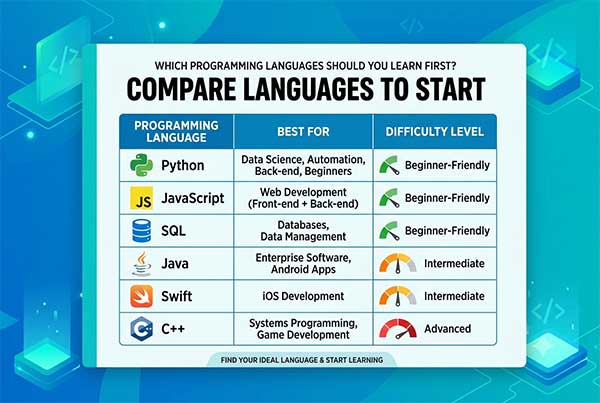
Start with one language and go deep before branching out. Trying to learn multiple languages simultaneously is one of the most common mistakes beginners make.
| Language | Best For | Difficulty Level |
|---|---|---|
| Python | Data, automation, back-end, beginners | Beginner-friendly |
| JavaScript | Web development (front + back-end) | Beginner-friendly |
| SQL | Databases, data management | Beginner-friendly |
| Java | Enterprise software, Android apps | Intermediate |
| Swift | iOS development | Intermediate |
| C++ | Systems programming, game dev | Advanced |
For most beginners aiming to land their first developer job quickly, Python or JavaScript is the strongest starting point. Both have enormous job markets, extensive learning resources, and broad applicability across industries.
What Are the Best Alternative Paths to Become a Software Developer?
Trade School and Diploma Programs
Trade schools and technical colleges offer structured software development programs that typically run between several months and two years. These programs are designed with employment outcomes in mind—covering practical, job-ready skills rather than theoretical computer science coursework.
ATA College’s Software Development and Programming program is one example, preparing students for entry-level development roles through hands-on training in programming fundamentals, application development, and industry-relevant tools. Trade school programs often cost significantly less than a 4-year university degree while delivering focused, career-specific training.
Best for: People who want structured instruction, accountability, and a clear timeline to employment-ready skills.
Coding Bootcamps
Coding bootcamps are intensive, short-term programs (typically 3–6 months) focused on getting students job-ready fast. Many are available online, part-time, or full-time. Some offer income-share agreements, meaning you pay tuition after you land a job.
Well-known options include General Assembly, Springboard, App Academy, and Flatiron School.
Best for: Career changers who can commit to full-time or near-full-time learning and want rapid results.
Community College Courses
Many community colleges offer individual computer science or programming courses without requiring enrollment in a full degree program. These courses are typically inexpensive and can help build foundational skills.
Best for: Those who want formal instruction at a low cost and aren’t in a hurry.
How Do You Build a Portfolio Without Work Experience?
A portfolio is your proof of work. Without a degree, it becomes your primary credential—and building one is entirely within your control, regardless of experience level.
Here’s how to build a strong developer portfolio from scratch:
- Start with personal projects. Build things that interest you. A weather app, a to-do list manager, a personal budget tracker—these simple projects demonstrate practical ability.
- Contribute to open-source projects. Platforms like GitHub host thousands of open-source projects welcoming beginner contributions. Even small bug fixes show real-world collaboration.
- Rebuild existing products. Pick a simple app you use and try to recreate it. This demonstrates understanding of product logic and UX thinking.
- Complete guided project-based courses. Many online platforms include capstone projects designed for your portfolio.
- Document everything on GitHub. Every project should live in a public GitHub repository with a clear README explaining what it does and how you built it.
Aim for 3–5 strong, polished projects rather than a large volume of incomplete work. Quality signals competence. Quantity without quality signals the opposite.
What Certifications Can Help You Get Hired as a Developer?
Certifications won’t replace a portfolio, but they add credibility—especially for roles involving specific platforms or tools.
Relevant certifications for aspiring developers include:
- AWS Certified Developer – For cloud-based development roles
- Google Associate Cloud Engineer – Cloud infrastructure and development
- Microsoft Certified: Azure Developer Associate – Azure platform development
- CompTIA IT Fundamentals (ITF+) – A strong entry-level credential covering broad tech concepts
- Meta Front-End Developer Professional Certificate (via Coursera) – Portfolio-ready front-end skills
Each of these can be earned without a degree and signals to employers that you’ve validated your skills through a standardized assessment.
How Long Does It Take to Become a Software Developer Without a Degree?
Timeline varies based on your starting point, how many hours per week you dedicate to learning, and which path you choose.
| Path | Typical Timeline |
|---|---|
| Trade school program | 6–18 months |
| Full-time coding bootcamp | 3–6 months |
| Part-time bootcamp or online course | 9–18 months |
| Self-directed learning only | 1–3+ years (highly variable) |
The honest answer: most people need at least 6–12 months of consistent effort before they’re genuinely job-ready for an entry-level role. Rushing the process often leads to gaps in foundational knowledge that surface in technical interviews.
How Do You Actually Get Hired as a Developer Without a Degree?
Landing your first developer job without a degree is a numbers game combined with a positioning game. Here’s what works:
Target the Right Roles
Search specifically for “junior developer,” “entry-level developer,” or “associate software engineer” roles. Some job postings will still list a degree as a requirement—apply anyway if your portfolio and skills are strong. Many hiring managers treat degree requirements as preferences, not hard filters.
Network Actively
A significant percentage of jobs are filled through referrals before they’re publicly posted. Attend local tech meetups, join developer communities on Discord or Slack, connect with engineers on LinkedIn, and engage genuinely with the industry.
Nail the Technical Interview
Most developer interviews include a technical component—either a take-home project or a live coding challenge. Platforms like LeetCode and HackerRank are widely used to practice. Consistent practice over weeks and months matters more than cramming.
Be Transparent About Your Path
Trying to hide the absence of a degree usually backfires. Instead, own your path. Explain what you’ve built, what you’ve learned, and how you’ve demonstrated the skills the role requires. Hiring managers respect candidates who can articulate their own development clearly.
Is a Trade School Faster Than a University Degree for Entering Software Development?
Yes—trade school is significantly faster than a 4-year university degree for entering an entry-level software development role. A focused trade school or technical program can prepare students for employment in 6 to 18 months, compared to 4 years for a bachelor’s degree.
As explained in ATA College’s post on community college vs. trade school, the key difference lies in focus: trade schools teach the specific skills employers need, while university programs cover a broader range of theoretical coursework—not all of which is directly applicable to entry-level jobs.
For someone whose primary goal is to enter the workforce quickly, a trade school program often offers a better time-to-employment ratio.
Start Your Path into Software Development
The demand for software developers continues to climb—and the barrier to entry has never been lower for motivated learners willing to put in the work. Whether you choose a trade school program, a bootcamp, or self-directed learning, the fundamentals are the same: learn the right skills, build real projects, and show employers what you can do.
If you’re ready to take a structured, career-focused approach, ATA College’s Software Development and Programming program offers hands-on training designed to prepare you for entry-level roles in the field. No four-year commitment required—just the skills, the portfolio, and the drive to get started.
Frequently Asked Questions
Can you become a software developer without any college education?
Yes. Many working software developers have no college education. The tech industry is among the most skills-based hiring environments across any sector. A strong portfolio, demonstrated proficiency in relevant programming languages, and the ability to pass technical interviews can substitute for a degree at most employers.
What is the fastest way to become a software developer?
A full-time coding bootcamp (3–6 months) is typically the fastest structured path to employment-ready skills. Trade school programs (6–18 months) offer a balance of speed and depth. Self-directed learning is possible but generally takes longer due to the lack of external structure.
Do companies like Google and Amazon hire developers without degrees?
Yes. Google, Amazon, Apple, IBM, and Meta have all publicly removed or reduced degree requirements for many technical roles. These companies primarily evaluate candidates through technical skills assessments and interviews, not academic credentials.
How important is a portfolio for getting hired as a developer?
A portfolio is essential for candidates without a degree. It serves as concrete evidence of your skills and your ability to build functional software. Most hiring managers will review a GitHub profile or portfolio site before deciding whether to invite a candidate for an interview.
What programming language should a complete beginner learn first?
Python is widely recommended for complete beginners due to its readable syntax, versatile applications (web development, data science, automation), and large job market. JavaScript is equally strong for those specifically targeting web development.
Is a trade school software development program worth it?
Trade school programs are worth considering for learners who benefit from structured instruction, a defined timeline, and career-focused curriculum. They typically cost less than a 4-year degree and are designed specifically to prepare students for entry-level employment rather than academic research careers.
How long does it take to build a portfolio as a beginner developer?
Building a portfolio of 3–5 solid projects typically takes 3–6 months for someone learning part-time. The goal isn’t perfection—it’s demonstrating that you can take a project from concept to completion using real code. Starting with small, functional projects and iterating over time is more effective than waiting until you feel “ready.”